

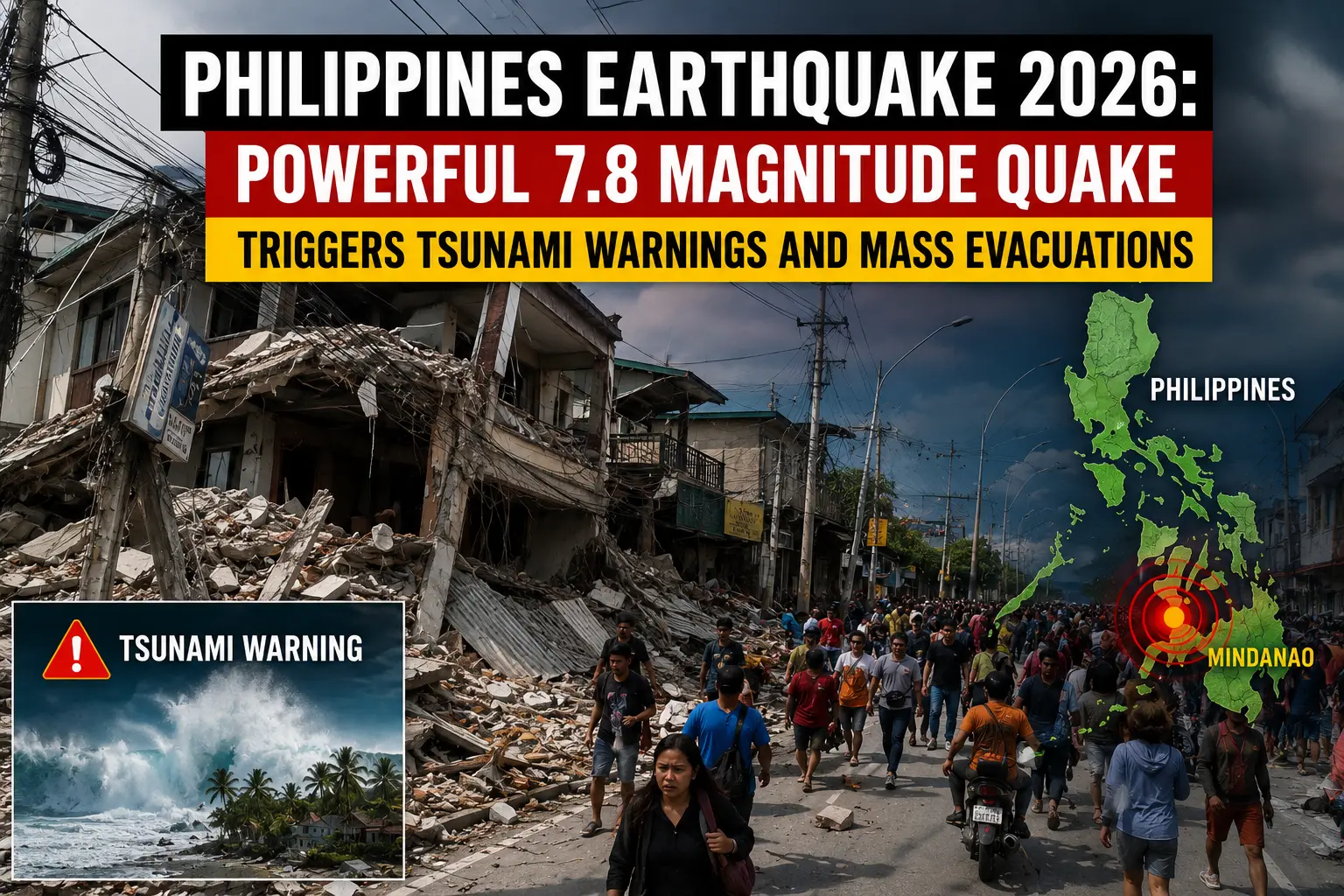
The Philippines has once again been reminded of its vulnerability to powerful seismic events after a major earthquake struck the southern part of the country in June 2026. The quake triggered tsunami warnings, widespread evacuations, infrastructure damage, and fears of significant casualties.
Seismologists: Experts note that shallow earthquakes near populated coastal regions often pose greater risks because they generate stronger ground shaking and can trigger tsunami activity.
As emergency crews continue assessing the affected areas, authorities are urging residents to remain cautious due to ongoing aftershocks and potential secondary hazards. This article provides the latest updates on the Philippines earthquake, its impact on communities, government response efforts, and expert analysis of what may happen next.
Philippines Earthquake – Overview
| Category | Details |
|---|---|
| Event | Major Earthquake |
| Location | Mindanao, Southern Philippines |
| Magnitude | 7.8 |
| Date | June 2026 |
| Epicenter | Near General Santos City |
| Depth | Approximately 10 km |
| Tsunami Warning | Issued Following the Quake |
| Aftershocks | Multiple Strong Aftershocks Reported |
| Emergency Response | Ongoing |
What Happened?
A powerful magnitude 7.8 earthquake struck off the southern coast of Mindanao near General Santos City, causing intense shaking across a large portion of the southern Philippines. The quake occurred at a relatively shallow depth, which increased the strength of ground shaking felt by residents. Authorities immediately issued tsunami warnings and evacuation orders for coastal communities.
Residents reported buildings swaying violently, power outages, damaged infrastructure, and widespread panic as people rushed outdoors for safety. Emergency agencies activated disaster response protocols within minutes of the earthquake.
Tsunami Warnings Trigger Mass Evacuations
One of the most serious concerns following the earthquake was the possibility of a tsunami.
The Philippine Institute of Volcanology and Seismology warned that waves could exceed normal tide levels, prompting coastal residents to move inland and seek higher ground. Similar alerts were issued for parts of Indonesia and Malaysia due to the quake’s location in the Philippine Sea.
Disaster Management Officials: Emergency responders have emphasized that aftershocks remain a significant threat and residents should continue monitoring official advisories.
The Pacific Tsunami Warning Center warned that waves as high as 3 meters could affect some Philippine coastlines. Smaller waves were also forecast for neighboring countries. In several coastal villages across Mindanao, emergency sirens sounded and evacuation centers quickly filled with residents seeking safety. Authorities emphasized that even relatively small tsunami waves can create dangerous currents and flooding.
Damage Assessment Continues
Initial reports indicate damage to buildings, roads, utilities, and public infrastructure throughout parts of southern Mindanao.
Witnesses described:
- Cracked walls and structural damage
- Falling debris
- Damaged vehicles
- Temporary power outages
- Telecommunications disruptions
- School closures
Several commercial structures reportedly sustained damage, while some public buildings required immediate inspections before reopening. Emergency responders continue evaluating affected areas to determine the full extent of losses.
Casualty Reports Under Review
Authorities are currently verifying reports of fatalities linked to the earthquake.
Disaster management officials in General Santos stated that reports of at least five deaths were being investigated while rescue and assessment operations continue. Officials cautioned that casualty figures could change as more information becomes available from remote communities. Search-and-rescue teams have been deployed to affected areas to assist injured residents and inspect damaged structures.
Strong Aftershocks Keep Residents on Edge
Following the main earthquake, multiple aftershocks were recorded across the region.
One significant aftershock measured magnitude 6.1 and was felt by millions of people throughout Mindanao. Seismologists warn that aftershocks can continue for days or even weeks after a major earthquake and may cause additional damage to already weakened buildings. Authorities have advised residents to remain alert and avoid entering heavily damaged structures until safety inspections are completed.
Why the Philippines Experiences Frequent Earthquakes?
The Philippines sits along the Pacific Ring of Fire, one of the most seismically active regions on Earth.
The Ring of Fire is a vast zone where several tectonic plates interact, creating:
- Earthquakes
- Volcanic eruptions
- Tsunamis
- Seafloor movement
Because of its location, the Philippines experiences thousands of earthquakes every year, although most are too small to be felt by the public. Major earthquakes, however, can cause devastating consequences.
Government Response and Emergency Measures
Philippine authorities moved quickly following the earthquake.
Emergency actions included:
Coastal Evacuations
Residents in tsunami-prone areas were ordered to move inland.
Emergency Shelters
Temporary shelters were established for displaced families.
Infrastructure Inspections
Engineers began evaluating bridges, schools, hospitals, and government buildings.
Search and Rescue Operations
Emergency teams were dispatched to assist affected communities.
President Ferdinand Marcos Jr. urged residents to prioritize safety and follow official instructions during the emergency response period.
Economic and Community Impact
Beyond the immediate physical damage, earthquakes often create significant economic disruptions.
Affected regions may experience:
- Business closures
- Transportation interruptions
- Utility outages
- School suspensions
- Temporary displacement of residents
The long-term financial impact will depend on the extent of infrastructure damage and recovery costs. Local governments are currently gathering information to determine assistance requirements.
Dr. Teresito Bacolcol, Philippine Seismology Agency Director: “The waves may continue for hours.” Coastal residents were urged to evacuate and move to higher ground following the tsunami warning.
What Happens Next?
Recovery efforts are expected to continue throughout the coming weeks.
Authorities will focus on:
- Confirming casualty numbers
- Restoring utilities
- Repairing damaged infrastructure
- Conducting structural inspections
- Supporting displaced families
Meanwhile, seismologists will continue monitoring aftershocks and assessing whether additional seismic activity could occur in the region.
Residents are encouraged to remain informed through official government and disaster-management channels.
Final Thoughts
The June 2026 Philippines earthquake serves as a powerful reminder of the country’s exposure to natural disasters. The magnitude 7.8 quake caused widespread concern across Mindanao, triggered tsunami warnings, damaged infrastructure, and prompted large-scale emergency responses.
While authorities continue evaluating the full extent of the disaster, the focus remains on protecting lives, assisting affected communities, and restoring essential services. With aftershocks still occurring and damage assessments ongoing, residents are encouraged to stay vigilant and follow official guidance. As recovery efforts continue, the resilience of local communities and emergency responders will play a critical role in helping the affected regions rebuild and recover from one of the strongest earthquakes to strike the Philippines in recent years.
FAQs
The earthquake measured magnitude 7.8 and struck near General Santos City in Mindanao.
Yes. Authorities issued tsunami warnings and evacuation orders for vulnerable coastal areas following the earthquake.
Authorities are verifying reports of at least five deaths, although investigations remain ongoing.
The Philippines is located on the Pacific Ring of Fire, where several tectonic plates meet and frequently generate seismic activity.
Yes. Multiple aftershocks have already occurred, and experts warn that additional tremors may continue in the coming days and weeks.











Leave a Reply