
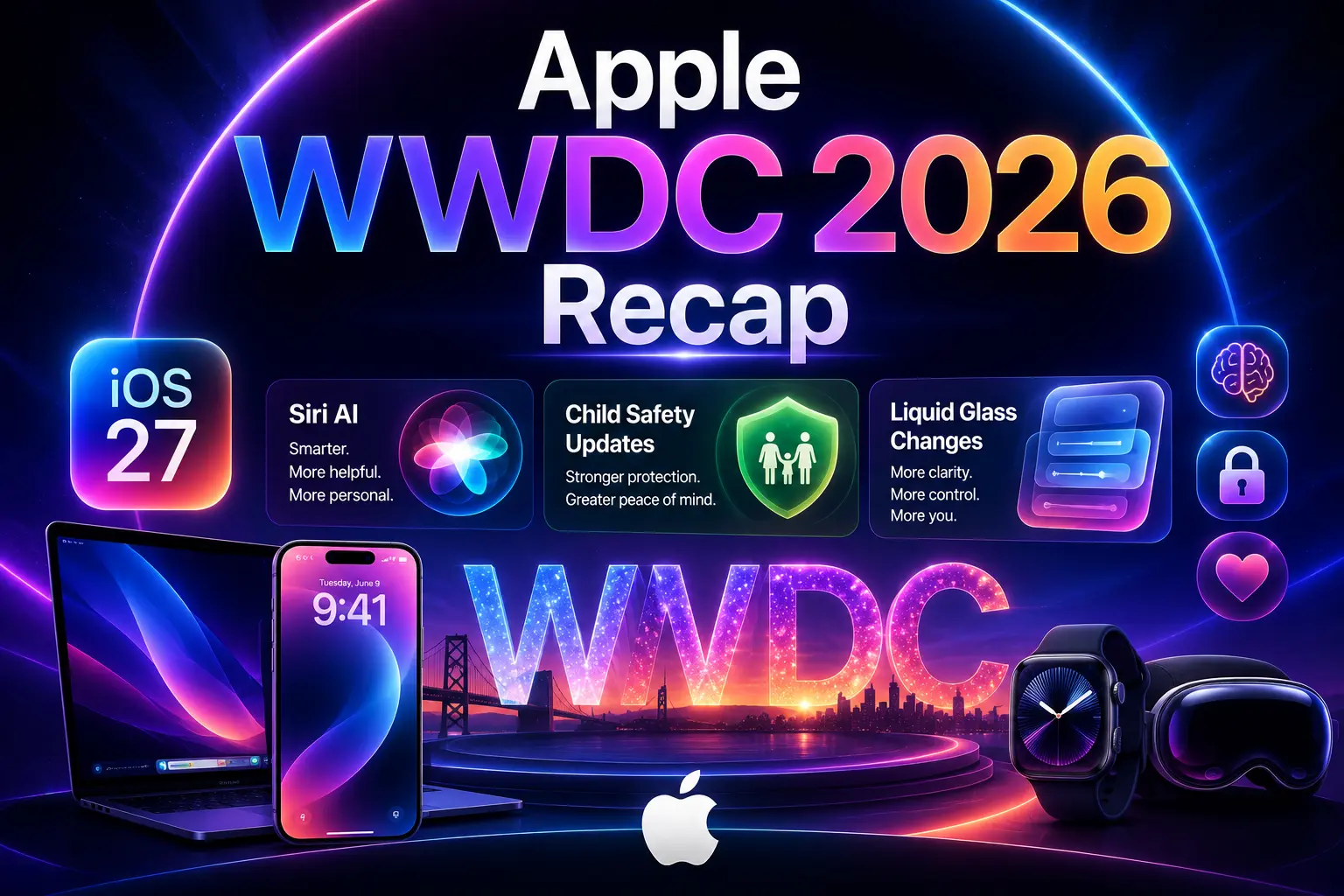
Apple’s Worldwide Developers Conference (WWDC) 2026 has delivered some of the company’s most significant software announcements in years. The event focused heavily on artificial intelligence, online safety for children, and major refinements to Apple’s controversial Liquid Glass design language.
After months of speculation, Apple officially unveiled its next-generation AI-powered Siri, introduced new child safety features across its ecosystem, and addressed user concerns about the Liquid Glass interface with important usability improvements. The announcements signal Apple’s determination to strengthen its position in the rapidly evolving AI landscape while maintaining its longstanding emphasis on privacy and user experience.
WWDC 2026: A Turning Point for Apple
WWDC has traditionally been the stage where Apple showcases the future of its software ecosystem. This year, however, expectations were particularly high.
Following delays in the rollout of advanced AI features and growing competition from AI-focused companies, Apple entered WWDC 2026 with pressure to demonstrate meaningful progress. The company responded with a clear focus on three key pillars:
- Artificial Intelligence
- Child Safety
- User Experience Improvements
Apple executives emphasized that the company’s strategy revolves around making technology smarter, safer, and easier to use across all devices.
Siri AI Finally Arrives
The biggest headline from WWDC 2026 was undoubtedly the introduction of Siri AI.
For years, Siri lagged behind competing AI assistants in conversational abilities, context awareness, and productivity. Apple has now completely reimagined the assistant with a more advanced AI architecture designed to understand users more naturally and perform more sophisticated tasks.
What Makes Siri AI Different?
The new Siri AI offers:
Improved Context Awareness
Users can now ask follow-up questions without repeatedly providing context.
For example:
- “Show me photos from my vacation.”
- “Now send the best ones to Mom.”
Siri AI understands the connection between both requests.
More Natural Conversations
Apple has redesigned Siri’s language model to make interactions feel less robotic and more conversational. Users can speak naturally rather than relying on specific commands.
Dedicated Siri App
One surprising addition is a standalone Siri AI application that stores conversation history and syncs interactions across Apple devices through iCloud. This brings Siri closer to experiences offered by modern AI chatbots.
Enhanced Voice Experience
Apple has also introduced more expressive voice options, improved dictation accuracy, and better speech recognition capabilities.
Apple Intelligence Gets Smarter
The Siri upgrade is part of a broader expansion of Apple Intelligence.
Apple Intelligence now integrates more deeply across:
- iPhone
- iPad
- Mac
- Apple Watch
- Vision Pro
The company says AI functions will work seamlessly across apps while preserving privacy through on-device processing whenever possible. This marks Apple’s most aggressive AI strategy since the introduction of Apple Intelligence.
Child Safety Becomes a Major Focus
Another major announcement centered on protecting children online. Apple executives highlighted trust and safety as one of the company’s core priorities moving forward. New tools are being added across Apple platforms to help parents better manage children’s digital experiences.
New Child Safety Features
Expanded Communication Protections
Apple is improving safeguards designed to detect and limit the sharing of inappropriate content involving minors.
Stronger Family Controls
Parents will gain additional tools to:
- Manage screen time
- Monitor app usage
- Approve downloads
- Control communication settings
Enhanced Privacy Protections
Apple continues emphasizing privacy-first approaches, ensuring children’s data remains protected while still allowing families to benefit from modern digital tools.
Liquid Glass Gets a Major Makeover
One of the most discussed topics from WWDC 2025 was Apple’s introduction of Liquid Glass, a new design language featuring translucent, glass-like interface elements. While many users praised the futuristic appearance, others complained that transparency levels made certain screens difficult to read. Apple has listened to that feedback.
What Is Liquid Glass?
Liquid Glass is Apple’s visual design system that combines transparency, depth effects, reflections, and dynamic motion throughout iOS, macOS, iPadOS, watchOS, and other platforms. The design aims to create a more immersive experience while keeping content front and center.
New Changes to Liquid Glass in 2026
At WWDC 2026, Apple announced several significant improvements.
Transparency Slider
The most requested feature has finally arrived. Users can now adjust transparency levels through a dedicated slider, allowing them to customize the appearance of Liquid Glass from highly transparent to more opaque. This directly addresses readability complaints raised by users over the past year.
Better Accessibility
Apple has refined contrast levels and visual layering to improve readability across different lighting conditions.
These changes are expected to benefit:
- Older users
- Visually impaired users
- Outdoor device users
More Personalization
Users can now select different opacity levels, visual styles, and color variations to better match their preferences.
iOS 27 Brings the New Features Together
The updated Siri AI and enhanced Liquid Glass interface are arriving as part of iOS 27. Apple says iOS 27 will continue supporting devices as old as the iPhone 11, allowing millions of users to access the latest software features without upgrading hardware.
Key iOS 27 highlights include:
- Siri AI integration
- Liquid Glass customization
- Improved Apple Intelligence
- Child safety enhancements
- Performance optimizations
- Enhanced accessibility features
Why WWDC 2026 Matters?
WWDC 2026 represents more than just another software update.
For Apple, the event signals:
A Stronger AI Strategy
The company is actively competing with other AI leaders by making Siri significantly smarter and more capable.
A Focus on Trust
Child safety initiatives reinforce Apple’s reputation as a privacy-focused technology company.
Listening to Users
Liquid Glass improvements demonstrate Apple’s willingness to respond to customer feedback and refine ambitious design changes.
Latest Update
As of June 2026, developers are already receiving early access to the new software platforms announced at WWDC. Public beta testing is expected later this year, with full consumer releases scheduled for the fall alongside Apple’s next-generation hardware lineup. Siri AI will initially launch with English-language support before expanding to additional languages in future updates.
Final Thoughts
WWDC 2026 may be remembered as one of Apple’s most important software events in recent years. The unveiling of Siri AI marks a major step forward for Apple’s artificial intelligence ambitions, while new child safety protections reinforce the company’s commitment to digital well-being.
At the same time, Apple’s decision to refine Liquid Glass instead of abandoning it demonstrates a balanced approach to innovation—introducing bold ideas while listening carefully to user feedback. With Siri AI, smarter Apple Intelligence, enhanced safety tools, and a more customizable interface, Apple has laid the foundation for a new generation of software experiences. As iOS 27 and related platforms move toward public release, users can expect one of the most significant upgrades to the Apple ecosystem in years.
FAQs
Siri AI is Apple’s new AI-powered version of Siri that offers improved conversational abilities, contextual understanding, and deeper integration across Apple devices.
Apple added a transparency slider, improved readability, enhanced accessibility, and introduced more customization options for users.
Apple expanded parental controls, communication protections, screen-time management tools, and privacy safeguards for children.
Yes. Apple announced that iOS 27 will support devices as old as the iPhone 11.
Developer access began at WWDC 2026, public beta testing is expected later this year, and full release is anticipated with the fall software rollout.




Leave a Reply