

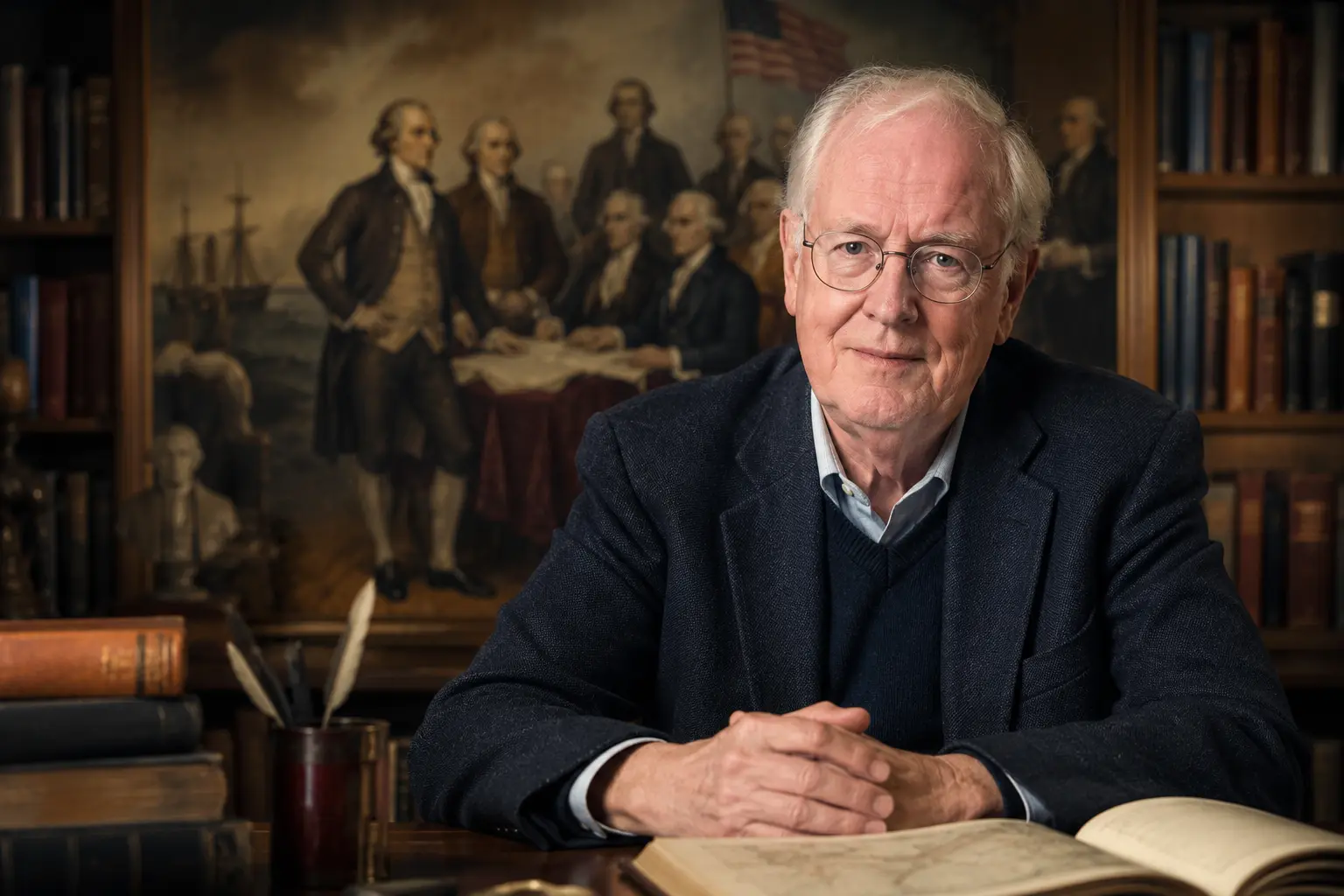
The world of American history lost one of its most influential voices in 2026 with the passing of historian Gordon S. Wood. For decades, Wood shaped how students, scholars, and everyday Americans understood the nation’s founding, the American Revolution, and the birth of democracy in the United States.
Known for his meticulous research and compelling interpretations of early American history, Wood became one of the most respected historians of the Revolutionary era. His books remain essential reading for anyone seeking to understand how America transformed from a collection of British colonies into an independent republic. With renewed interest in America’s founding ahead of the nation’s 250th anniversary celebrations, Gordon Wood’s legacy remains more relevant than ever.
Latest Update – Gordon Wood Dies at Age 92
In June 2026, Gordon Wood passed away at the age of 92 after being struck by a vehicle in Rhode Island. His death prompted tributes from historians, universities, authors, and political leaders across the United States. Wood was widely recognized as one of the most influential scholars of the American Revolution and the founding era.
His work transformed historical scholarship by emphasizing how the Revolution fundamentally changed American society, politics, and ideas about equality and democracy. Even critics acknowledged his enormous influence on the field of American history.
Early Life and Education
Gordon Stewart Wood was born on November 27, 1933, in Concord, Massachusetts, a town deeply connected to American history. Growing up surrounded by Revolutionary War landmarks helped spark his interest in the nation’s origins. After earning his undergraduate degree from Tufts University, Wood pursued graduate studies in history and eventually became a student of renowned historian Bernard Bailyn, whose influence helped shape Wood’s intellectual development. His academic journey ultimately led him to become one of America’s foremost experts on the Revolutionary era.
A Distinguished Academic Career
Much of Wood’s professional career was spent at Brown University, where he taught generations of students and established himself as one of the leading historians in the United States. His lectures were known for combining scholarly rigor with accessible storytelling, making complex historical ideas understandable to broader audiences. Over the years, Wood also held positions and visiting appointments at several prestigious institutions, further cementing his reputation within the academic community.
The Book That Changed Revolutionary History
Wood’s breakthrough came with the publication of The Creation of the American Republic, 1776–1787. The book examined how Americans developed new political institutions and ideas following independence. It quickly became one of the most influential studies of the founding period and earned Wood the prestigious Bancroft Prize.
Historians praised the work for its deep analysis of constitutional thought and its examination of how Americans struggled to create a functioning republic after breaking away from Britain. Even decades later, many scholars continue to regard it as one of the most important books ever written about the American founding.
Pulitzer Prize Success
Wood achieved even greater recognition with his landmark book The Radicalism of the American Revolution. Published in the early 1990s, the book argued that the American Revolution was far more socially transformative than many historians previously believed. According to Wood, the Revolution fundamentally altered relationships between ordinary citizens, political leaders, and institutions. The book won the Pulitzer Prize for History in 1993 and remains one of the most widely cited works on the Revolutionary era.
Wood’s Interpretation of the American Revolution
One reason Gordon Wood became so influential was his unique interpretation of the Revolution. While some historians focused primarily on economic factors, Wood emphasized the power of ideas.
He argued that concepts such as:
- Liberty
- Equality
- Republican government
- Popular sovereignty
- Individual rights
were central to understanding why the Revolution mattered. Wood believed the Revolution created a society unlike any that had existed before, transforming social structures and encouraging democratic participation. This interpretation shaped decades of historical scholarship and public understanding.
Influence Beyond Academia
Although Wood spent most of his career in universities, his influence extended well beyond academic circles. His books reached general readers, and his expertise was frequently sought by journalists, documentary filmmakers, and public institutions. He contributed to historical projects, museum programs, and discussions about America’s founding principles. Wood even became part of popular culture when he was humorously referenced in the film Good Will Hunting, introducing many Americans to his name.
Debates and Criticism
Like many influential scholars, Wood’s work sparked debate. Some younger historians argued that his narratives focused too heavily on political leaders and insufficiently addressed the experiences of women, Native Americans, African Americans, and other marginalized groups.
Wood acknowledged the importance of expanding historical perspectives but maintained that political ideas and institutions remained central to understanding the nation’s development. His willingness to engage with critics while defending his scholarship earned respect across ideological lines.
America’s 250th Anniversary and Wood’s Legacy
As the United States approaches the 250th anniversary of independence, interest in the founding era has increased significantly. Shortly before his death, Wood continued discussing figures such as Benjamin Franklin and the lasting significance of the Revolution. He remained active in public conversations about American history and constitutional principles. Many historians believe his books will remain essential reading for future generations seeking to understand America’s origins.
Awards and Honors
Throughout his career, Wood received numerous prestigious awards, including:
- Pulitzer Prize for History
- Bancroft Prize
- National Humanities Medal
- Multiple honorary degrees
- National historical and academic recognitions
In 2010, he received the National Humanities Medal from Barack Obama, recognizing his contributions to American intellectual life.
Why Gordon Wood Still Matters Today?
In an era of intense political debate and competing interpretations of American history, Gordon Wood’s work continues to offer valuable perspective. His scholarship reminds readers that understanding the past requires careful analysis rather than simple political narratives.
Wood consistently argued that history should not be viewed solely as a story of heroes or villains. Instead, he believed historians should seek to understand people and events within their historical context. That approach remains one of his most enduring contributions.
Final Thoughts
Few historians have influenced the study of American history as profoundly as Gordon Wood. Through decades of research, teaching, and writing, he reshaped how Americans understand the Revolution, the Constitution, and the nation’s founding ideals.
His books remain foundational works for students, scholars, and history enthusiasts alike. Even as new interpretations emerge and historical debates continue, Wood’s commitment to rigorous scholarship and thoughtful analysis ensures that his contributions will endure for generations. As America prepares to commemorate 250 years of independence, Gordon Wood’s work serves as a reminder that understanding the nation’s past remains essential to understanding its future.
FAQs
Gordon Wood was an American historian and professor best known for his scholarship on the American Revolution and the founding of the United States.
He is most famous for writing The Radicalism of the American Revolution and The Creation of the American Republic, 1776–1787.
Yes. He won the Pulitzer Prize for History in 1993 for The Radicalism of the American Revolution.
Wood argued that the Revolution transformed American society by promoting equality, democracy, and individual liberty.
Gordon Wood died in June 2026 at the age of 92 following a traffic accident in Rhode Island.


Leave a Reply