

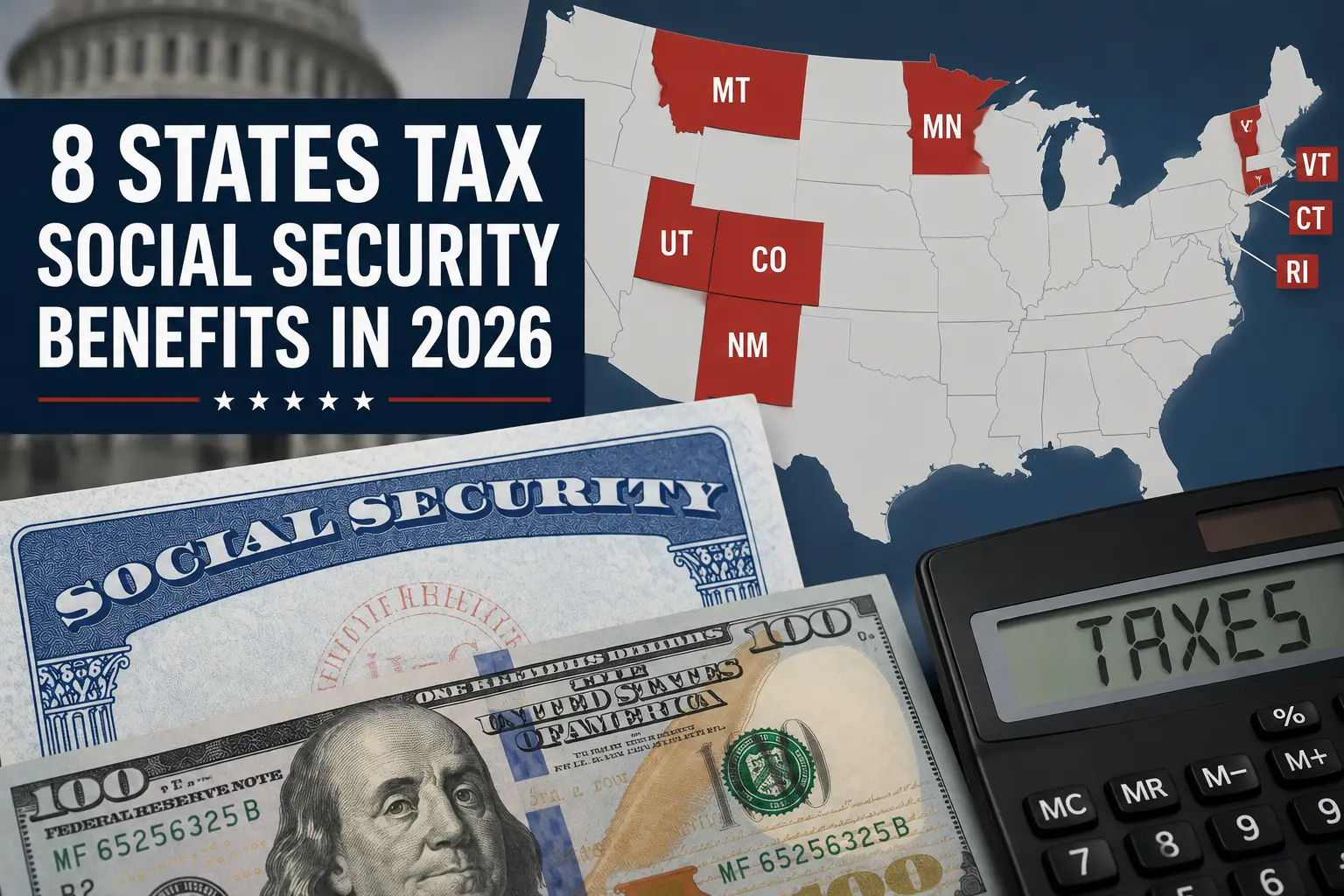
In 2026, eight states still tax some Social Security benefits, while the other 42 states do not tax Social Security at the state level. However, there is an important catch: living in one of those eight states does not automatically mean you will owe state tax on your benefits. Income, age and filing status can make a major difference. That makes this issue particularly important for retirees deciding where to live, people planning retirement, and beneficiaries trying to estimate their true after-tax income. Here is what you need to know for 2026.
The 8 States That Tax Social Security Benefits in 2026
The eight states that continue to tax at least some Social Security income are:
- Colorado
- Connecticut
- Minnesota
- Montana
- New Mexico
- Rhode Island
- Utah
- Vermont
The rules are different in every state, and many retirees can qualify for deductions, exemptions or credits that eliminate the state tax entirely.
1. Colorado
Colorado is one of the states where age and income can significantly affect the tax treatment of Social Security. For taxpayers age 65 or older, Colorado generally allows a subtraction for Social Security benefits included in federal taxable income. Taxpayers ages 55 to 64 can also receive favorable treatment subject to state rules and income limits. This means a Colorado retiree should not assume that simply receiving Social Security will result in a state tax bill.
2. Connecticut
Connecticut uses income thresholds to determine whether Social Security benefits are subject to state taxation. For 2026, Social Security benefits are fully exempt for single filers and married taxpayers filing separately when the applicable Connecticut adjusted gross income is below $75,000. The threshold is $100,000 for married couples filing jointly, qualifying surviving spouses and heads of household. Higher-income taxpayers may have some federally taxable Social Security included in their Connecticut tax calculation.
3. Minnesota
Minnesota provides a Social Security benefit subtraction rather than simply taxing every dollar of benefits. For 2026, taxpayers below certain income levels may subtract all Social Security benefits included in federal adjusted gross income under the state’s simplified method. The Minnesota Department of Revenue lists a threshold of $108,320 for married couples filing jointly and $84,490 for single or head-of-household filers, with the subtraction gradually phasing out above those amounts. Higher-income retirees may therefore still have some taxable Social Security income.
4. Montana
Montana remains one of the states where some Social Security benefits can be subject to state income tax. However, Montana has deductions and other provisions that can reduce the amount ultimately subject to taxation. The amount a retiree owes depends on overall income and the applicable state rules.
5. New Mexico
New Mexico technically continues to tax Social Security benefits, but changes to the state’s tax system have substantially expanded exemptions for many retirees. As a result, many lower- and middle-income beneficiaries may pay no New Mexico tax on their Social Security even though the state remains on the list of states that tax benefits in some circumstances. This is an important distinction: “taxes Social Security” does not necessarily mean “every retiree pays tax on Social Security.”
6. Rhode Island
Rhode Island also remains on the 2026 list. State taxation can depend on factors such as age, income and the amount of federally taxable Social Security. Retirees should review the current Rhode Island rules rather than assuming their entire Social Security check is taxable.
7. Utah
Utah continues to tax some Social Security benefits, although recent changes have expanded protections for certain taxpayers. The state’s treatment can depend on income and eligibility for available credits or exemptions. Utah has also faced continuing pressure to eliminate Social Security taxation altogether.
8. Vermont
Vermont is the eighth state on the 2026 list. The state’s rules provide exemptions based on income and filing circumstances, meaning many retirees may not actually pay state tax on their benefits. For higher-income beneficiaries, however, some Social Security income can remain subject to state taxation.
What About the Other 42 States?
The good news for most retirees is that 42 states do not tax Social Security benefits at the state level. That does not mean all 42 states have no income tax. Instead, many states with an income tax specifically exclude Social Security benefits from taxable income. States that do not tax Social Security include:
Alabama, Alaska, Arizona, Arkansas, California, Delaware, Florida, Georgia, Hawaii, Idaho, Illinois, Indiana, Iowa, Kansas, Kentucky, Louisiana, Maine, Maryland, Massachusetts, Michigan, Mississippi, Missouri, Nebraska, Nevada, New Hampshire, New Jersey, New York, North Carolina, North Dakota, Ohio, Oklahoma, Oregon, Pennsylvania, South Carolina, South Dakota, Tennessee, Texas, Virginia, Washington, West Virginia and Wisconsin, Wyoming.
West Virginia is particularly noteworthy because it completed its phase-out of Social Security taxation in 2026. Kansas, Missouri and Nebraska previously eliminated their Social Security taxes beginning in 2024.
Why State Social Security Taxes Matter for Retirees?
At first glance, the difference may seem small. But over several years, state taxation can affect a retiree’s overall retirement budget. Consider someone receiving $30,000 a year in Social Security. If that person also receives income from a traditional IRA, pension, investments or employment, their total income may affect whether some Social Security becomes taxable. That is why retirees should look at total retirement income, not just the amount of their Social Security check.
State taxes can also matter when someone is considering moving during retirement. A retiree comparing two states might look only at housing costs. But income taxes, property taxes, sales taxes, insurance costs and healthcare expenses can change the overall financial picture.
State Tax Is Different From Federal Tax
Another common misconception is that living in one of the 42 states that does not tax Social Security means the benefits can never be taxed. That is not correct. Federal income tax rules are separate from state rules. Depending on a person’s combined income, some Social Security benefits can be subject to federal income tax. The state exemption therefore does not necessarily eliminate federal taxation.
For retirees, this creates two separate questions: Does my state tax Social Security? and Will the federal government tax part of my Social Security? Both should be considered when estimating after-tax retirement income.
What Retirees Should Do Before Filing Taxes?
If you receive Social Security, don’t rely solely on a general list of states.
Instead, check:
- Your state of residence
- Filing status
- Adjusted gross income
- Age
- Other retirement income
- Pension income
- IRA or 401(k) withdrawals
- Investment income
- The amount of Social Security included in federal taxable income
State rules can change from one tax year to another, so it is important to check the rules for the specific year you are filing. For example, Minnesota publishes specific 2026 Social Security subtraction thresholds, while Connecticut uses different income thresholds. Colorado also has age-based subtraction rules.
Final Thoughts
The headline may sound simple: eight states tax Social Security while 42 don’t. But the reality is more nuanced. The eight states—Colorado, Connecticut, Minnesota, Montana, New Mexico, Rhode Island, Utah and Vermont—do not necessarily tax every retiree’s Social Security check. Income thresholds, age requirements, deductions and credits can protect many beneficiaries from owing state tax.
For retirees, the bigger lesson is that where you live can influence how much of your retirement income you ultimately keep. If you’re already retired, review your state’s current rules before filing. If you’re planning to move, compare the complete tax picture rather than looking only at Social Security taxation. And remember: state taxation is only one part of retirement planning. Federal taxes, Medicare costs, housing, property taxes and healthcare expenses can all have a significant impact on your monthly budget.
FAQs
The eight states are Colorado, Connecticut, Minnesota, Montana, New Mexico, Rhode Island, Utah and Vermont. However, each state provides different exemptions, deductions or income-based rules.
The other 42 states do not impose state income tax on Social Security benefits. This includes states such as Florida, Texas, Pennsylvania, California, New York, Illinois and West Virginia.
No. In many cases, income limits, age requirements, deductions or credits can completely eliminate the state tax on Social Security.
Yes. West Virginia completed its phase-out of Social Security taxation for the 2026 tax year, removing it from the list of states that tax Social Security benefits.
Yes. State and federal taxation are separate. A state may completely exempt Social Security while federal income tax rules can still apply to some benefits depending on the taxpayer’s overall income.




Leave a Reply